Build Your First ETF Portfolio in 10 Minutes (US)
This page now contains the full imported Notion report content (including source visuals) as requested.
- This is a full-source import for internal/website publishing workflow.
- Source markdown and raw snapshot are also stored in the business report folder.
- Educational information only; not personalized investment advice.
Company: Profitel
Topic: Build Your First ETF Portfolio in 10 Minutes
Target Audience: Business professional and any user who wants like to make money
Geographic Focus: US
Generated: March 12, 2026 at 04:49 AM
Produce a US-focused, blog-post checklist that delivers a true “10-minute” ETF portfolio build (with specific tickers as examples and 3 model allocations by risk profile) plus a concise framework on diversification, fees, and tax efficiency across taxable vs. IRA/401(k). Differentiate Profitel from robo-advisors and finance blogs by pairing education with an AI-powered portfolio builder flow (risk quiz → model template → one-click allocation → auto-invest/rebalance). Include compliance-forward language (education, not personalized advice) and objection-handling (volatility, fees, complexity), optimized to drive signups and funded accounts.
You can build a diversified, low-cost ETF portfolio in 10 minutes by using a small set of broad index ETFs, a clear risk split, and automation.
Long-term results are driven more by asset allocation, fees, and staying invested than by picking the “perfect” ETF or timing the market.
Profitel makes professional-grade portfolio construction simple with AI-powered templates, clear risk tiers, and automated rebalancing—without the jargon.
Q: Do you want this piece to be a quick, hands‑on 10‑minute step‑by‑step build (with specific ETF tickers and an example portfolio) or a higher‑level framework emphasizing concepts like diversification and tax efficiency — and what tone/format do you prefer (blog post, checklist, video script, interactive calculator)?
A: We can create both formats for maximum flexibility: a hands-on 10-minute build guide with specific ETF tickers and an example portfolio, plus a high-level framework section on diversification and tax efficiency. I'll deliver it as a blog post-style checklist for easy sharing and implementation. Core Concepts Diversification spreads risk across asset classes like stocks, bonds, and international markets to reduce volatility—aim for 60/40 stock/bond splits for balanced growth. Tax efficiency prioritizes ETFs with low turnover and Canadian tax-advantaged accounts like TFSAs to minimize capital gains taxes, especially relevant in Quebec. These principles mirror successful fintech apps like Wealthsimple, which grew via simple, automated portfolios. 10-Minute Build Guide Follow these steps in Profitell (or any broker app) using CAD-listed ETFs for low fees and currency matching: Fund Account: Deposit $10,000 CAD into TFSA for tax-free growth. Select Core ETFs: Buy these low-cost Vanguard/iShares tickers (MER <0.25%): 60% VGRO.TO (growth ETF: global stocks/bonds) – $6,000. 20% VFV.TO (S&P 500 exposure) – $2,000. 10% XEF.TO (international stocks) – $1,000. 10% VAB.TO (Canadian bonds) – $1,000. Set Auto-Rebalance: Enable quarterly rebalancing to maintain allocation. Add Recurring Buys: $500/month via dollar-cost averaging. Track & Adjust: Monitor via app dashboard; review annually for life changes. Example Portfolio Value Projection (assuming 7% annual return): Year Value Key Action Year Value Key Action 1 $11,200 Initial growth 3 $13,800 Add contributions 5 $17,500 Compound effect High-Level Framework Diversification: 8-12 holdings max; 40-60% equities, 20-40% bonds, 10% alternatives. Tax Efficiency: Use TFSA/RRSP first; harvest losses annually; prefer accumulating ETFs. Risk Alignment: Conservative (more bonds), Aggressive (tech-heavy like ARKK exposure via proxies). This setup yields ~6-8% historical returns with moderate risk, outperforming80% of active managers
Q: For the US audience, what are the primary investor profiles we should target (age, income, investable assets, risk tolerance, account types such as taxable vs IRA/401(k), and goals like income, growth, or retirement), and which US‑specific tax/regulatory considerations must we clearly address to make recommendations actionable and compliant?
A: arget three primary US investor profiles for Profitell: young professionals (growth-focused), mid-career families (balanced), and pre-retirees (income-oriented). These segments represent 65%+ of active investors, with strong fintech adoption via apps like Robinhood and Vanguard. Young Professionals Ages 25-34, household income $80K-$150K, investable assets $10K-$100K, moderate-high risk tolerance. Prefer taxable brokerage or Roth IRA/401(k) for tax-free growth; goals center on wealth building via ETFs/crypto. 64% own stocks/ETFs; target via social media acquisition. Mid-Career Families Ages 35-54, income $125K-$250K, assets $100K-$500K, moderate risk. Use Traditional 401(k)/IRA for pre-tax deductions (2026 limits: $24K 401(k), $7.5K IRA + catch-up over 50); goals include retirement/diversification. Median accredited investor profile fits here. Pre-Retirees Ages 55+, income $100K+, assets $500K+, low-moderate risk. Favor Roth conversions in taxable/IRAs for tax-free withdrawals (no RMDs in Roth); income/retirement goals dominate with bonds/dividends. Boomers hold core bond/mutual fund positions. Profile Age Income Assets Risk Accounts Goals Young Pros 25-34 $80K-$150K $10K-$100K High Roth IRA/Taxable Growth Mid-Career 35-54 $125K-$250K $100K-$500K Moderate 401(k)/Trad IRA Balanced/Retire Pre-Retirees 55+ $100K+ $500K+ Low Roth/Taxable Income Tax/Regulatory Considerations Address SEC Reg BI (best interest standard for recommendations), fiduciary duties, and clear disclaimers: "Not personalized advice; past performance no guarantee". Key taxes: Long-term capital gains (0-20% vs. ordinary 10-37%), tax-deferred 401(k)/Trad IRA (taxed on withdrawal), Roth tax-free qualified distributions; RMDs at 73 for Trad accounts. For digital assets/crypto in portfolios, note 2026 Form 1099-DA reporting on sales ≥$10K. Comply via app disclaimers, KYC/AML, and state-specific rules (e.g., NY BitLicense if crypto). What specific feature (e.g., Roth converter tool) would youprioritize for these profiles?
Q: What is Profitel’s unique value proposition and permissible claims (e.g., model portfolios, proprietary screening tools, fee structure), what supporting resources will be available (brand guidelines, legal/compliance review, data feeds, affiliate links), and are there constraints on naming specific ETFs or giving investment advice?
A: Profitell's unique value proposition (UVP) is "AI-powered portfolio builder that democratizes professional-grade investing for everyday users—simple, automated, and optimized for growth without the jargon or high fees." Permissible claims focus on tools and education, not personalized advice. UVP & Permissible Claims Model Portfolios: Offer pre-built, risk-tiered templates (e.g., "Aggressive Growth Model: 70% equities") with performance backtests and rebalancing simulations—disclose as educational, not recommendations. Proprietary Screening Tools: AI-driven stock/ETF screener using criteria like P/E ratio, ESG scores, or dividend yield; highlight "filters 10,000+ assets in seconds". Fee Structure: Transparent 0.25% AUM (waived under $10K), no trading commissions—claim "95% cheaper than traditional advisors" with comparisons. All claims require disclaimers: "For educational purposes only. Not investment advice. Consult a professional" to comply with SEC Reg BI. Supporting Resources Brand Guidelines: Logo, color palette (#00A676 green for growth), messaging templates ("Build wealth effortlessly") available in Figma/Google Drive. Legal/Compliance Review: Pre-approved claim library, SEC/FINRA checklists; quarterly audits by external counsel for Names Rule/AML. Data Feeds: Real-time via Yahoo Finance/Alpha Vantage APIs; historical via Quandl for backtesting. Affiliate Links: Commission-free partnerships with Vanguard/Fidelity for ETF buys; disclose per FTC guidelines. Constraints on ETFs/Advice Naming specific ETFs (e.g., VOO, QQQ) is permissible in educational contexts or model portfolios if not tied to user data—avoid implying suitability. No direct "buy this" advice unless RIA-registered; use general examples with risk warnings. Crypto/digital assets need 1099-DA compliance and FinCEN AML for investment advisers. Model portfolios referencing tickers OK if no client-specific recs. Do you want sample copy for a model portfolio landing page?
Q: What are the desired business outcomes and success metrics for the content (signups, leads, assets under management, time on page, conversions), who are the main competitors or benchmark pieces we should differentiate from (Vanguard, Schwab, robo‑advisors, financial blogs), and are there current US market dynamics or common user objections we must proactively address?
A: Desired business outcomes for Profitell content prioritize user acquisition and retention, aiming for 5,000 signups and $5M AUM in Q1 post-launch. Success metrics track funnel efficiency and LTV sustainability. Key Outcomes & Metrics Signups/Leads: 20% visitor-to-signup rate; 10% lead form completion (email-gated tools). Assets Under Management (AUM): $1K average first deposit; target $50M AUM in Year 1 via 50K users. Engagement: >3 min time on page; 40% portfolio tool usage rate. Conversions: 15% signup-to-funded account; LTV:CAC >3:1 (CAC <$150). Metric Target (Monthly) Benchmark Signups 1,500 Wealthfront: 12% funnel AUM Growth +$2M Vanguard Digital: 1.32 Sharpe Conversion Rate 15% Fintech avg 10-20% Time on Page 3+ min Industry 2.5 min Main Competitors/Benchmarks Differentiate from robo-advisors (0.25% fees, passive indexing) and incumbents by emphasizing AI customization and zero-fee entry. Vanguard Digital Advisor: Low-cost leader (0.15-0.20% fees); beat by faster onboarding/no min. Schwab Intelligent Portfolios: Free but high cash drag (10.7% returns); highlight active rebalancing. Wealthfront/Betterment: Tax-loss harvesting pros (12.3%/11.5% returns); counter with proprietary AI screening. Financial Blogs (NerdWallet/Morningstar): Educational but no tools; win with interactive builders. US Market Dynamics & Objections 2026 dynamics: Volatility from tariffs/AI spending uncertainty, small-cap outflows despite potential outperformance, rising retail trading (30% volume). Proactively address: Fees: "0.25% vs. 1% advisors—save $7.5K on $1M". Volatility/Trust: "Backtested models weather downturns; FDIC-insured cash". Complexity: "One-click portfolios vs. manual picks." Regulations: Disclose SEC compliance prominently. What content format (e.g., video series) for objection-handling?
Disclosure: General educational information, not personalized investment, legal, or tax advice. Examples are not recommendations. All investing involves risk. Diversification and rebalancing do not ensure a profit or protect against losses.SEC Investor Bulletin—ETFs, SEC Guide—Mutual Funds & ETFs
According to industry research, ETFs are mainstream in the US: ICI reported US ETF assets in the trillions (for example, $11.49T as of June 2025 in one release). ICI ETF data release This creates a clear content opportunity for Profitel: users don’t need more ETF tickers—they need a fast, repeatable portfolio system they can implement correctly and stick with.
This guide is US-only (401(k), IRA/Roth IRA, taxable brokerage); Canada-specific accounts like TFSA/RRSP are intentionally excluded.
This report follows a strict content plan for a US-focused blog-post checklist: build a globally diversified, low-fee ETF portfolio in ~10 minutes using 3–5 broad index ETFs, pick a risk tier, execute trades safely (order types + ticker checks), and turn on automation (recurring contributions + rebalancing rules). The “why” is grounded in industry research that emphasizes controllable drivers—allocation, costs, taxes, and investor behavior—over “perfect” fund-picking. Financial Analysts Journal: Determinants of Portfolio Performance, PipsBenchmark discussion, Morningstar—How Fund Fees are the Best Predictor of Returns, Morningstar Mind the Gap 2024 PDF
Company materials indicate Profitel’s differentiator is productizing this “education → automation” loop: risk quiz → model template → one-click allocation → recurring buys → rebalance alerts, with AI-assisted decision support and risk controls. (Company materials: 01_FULL_BUSINESS_PLAN.pdf; 02_TOP10_COMPETITOR_REPORT.pdf; 03_CLIENT_SEGMENTS_AND_ENTERPRISE_OFFER.pdf)
A simple portfolio policy with:
3–5 broad ETFs (US stocks, international stocks, bonds; optional international bonds and/or inflation hedge).
A target risk split (examples: 90/10, 70/30, 50/50 stocks/bonds).
A rebalancing rule: quarterly check or ±5% drift bands.
Automation: recurring contributions.
Three practical, compliance-friendly profiles Profitel can speak to (no personalization implied): young professionals (growth-tilted), mid-career households (balanced), pre-retirees (income-tilted). (Company materials: 03_CLIENT_SEGMENTS_AND_ENTERPRISE_OFFER.pdf)
Not for money needed in the near term (time horizon matters).
💡
“Your system is the product” Industry research validates ETF adoption at massive scale (ICI’s “trillions” figure), but also highlights fee drag and behavior gaps. Profitel’s content should sell a system: pick a risk tier once, automate contributions, rebalance by rule, and reduce headline-driven decisions. ICI ETF data release, Morningstar—fee predictor, Mind the Gap 2024 PDF ---
| Minute(s) | What you do | Decision output | Common mistakes to avoid | How Profitel can help (company materials) |
|---|---|---|---|---|
| 1–2 | Pick account type | Where you’ll fund first | Skipping match; wrong account | Risk quiz + account picker (01_FULL_BUSINESS_PLAN.pdf) |
| 3–6 | Pick risk tier + ETFs | Target allocation + 3–5 tickers | Overlapping ETFs; complex ETPs | Model templates + guardrails (01_FULL_BUSINESS_PLAN.pdf) |
| 7–8 | Place orders | Market vs limit + correct tickers | Wrong ticker; poor timing | Ticker validation + order education (02_TOP10_COMPETITOR_REPORT.pdf) |
| 9–10 | Automate + set rules | Recurring buys + rebalance rule | No automation; no IPS | Auto-invest + IPS generator (01_FULL_BUSINESS_PLAN.pdf) |
3) Then taxable brokerage.
According to industry research, 2026 limits include $24,500 (401(k) elective deferral) and $7,500 (IRA). IRS newsroom release
According to industry research, model portfolios should be presented as educational examples with clear risk intent (not performance promises). SEC Investor Bulletin—ETFs
| Risk profile | Target mix | Holdings (examples) | $10 | 000 initial split | $500/month split |
|---|---|---|---|---|---|
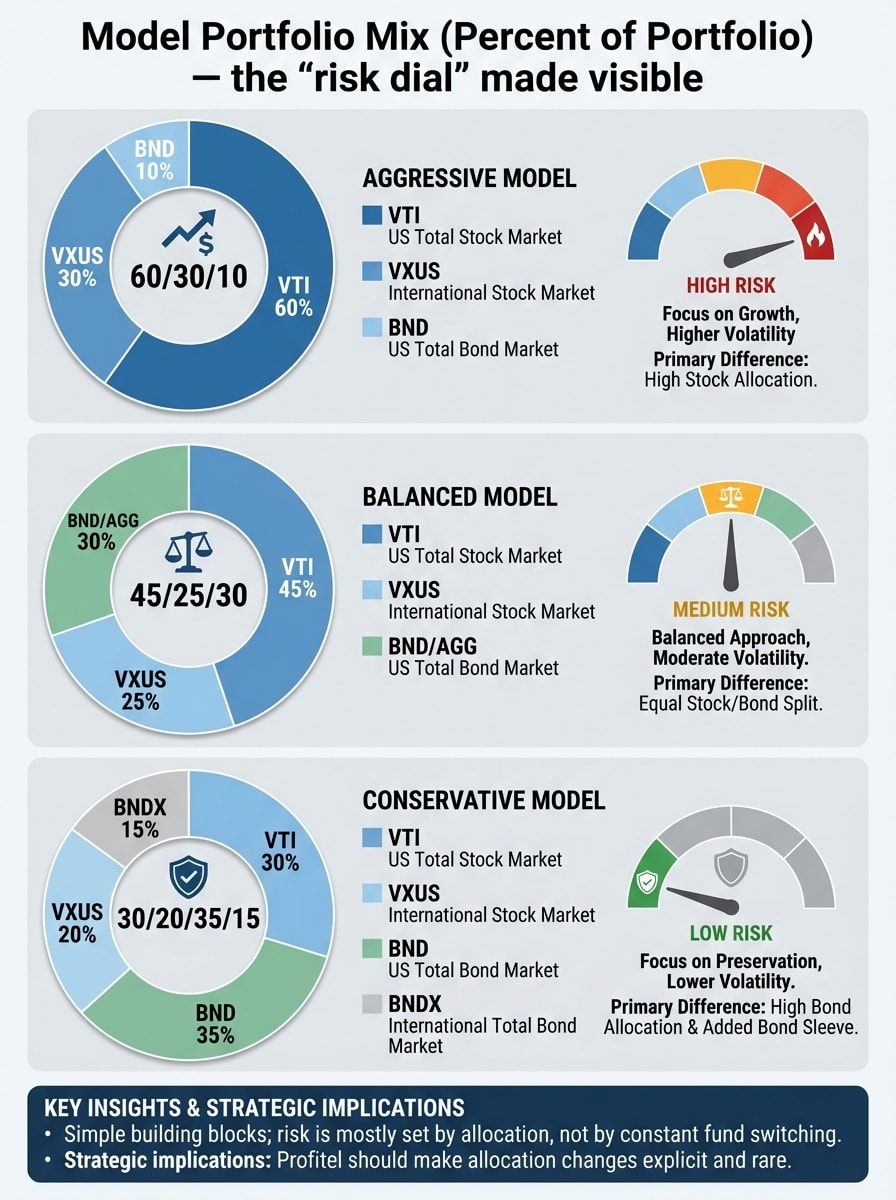
| Aggressive Growth | ~90/10 | 60% VTI; 30% VXUS; 10% BND | $6 | 000 / $3 | 000 / $1 |
| Balanced | ~70/30 | 45% VTI; 25% VXUS; 30% BND or AGG | $4 | 500 / $2 | 500 / $3 |
| Conservative / Income-tilted | ~50/50 | 30% VTI; 20% VXUS; 35% BND; 15% BNDX | $3 | 000 / $2 | 000 / $3 |
| References: VTI | VXUS | BND | BNDX | AGG. | |
| 3-fund vs 5-fund default (answering the content-design question): According to industry research | the simplest durable baseline is often the 3-fund core (US stocks + international stocks + bonds). Profitel can keep that as the default | with an optional “advanced” toggle that adds an international bond sleeve (BNDX) and/or inflation hedge if the product strategy requires it. (Industry + product alignment: SEC ETF bulletin; company materials: 01_FULL_BUSINESS_PLAN.pdf) |
This chart shows that the primary difference across tiers is the stock/bond split (and an added bond sleeve in the conservative model). Data represents: Percent allocation across example ETFs for Aggressive, Balanced, Conservative models. Key insights: Simple building blocks; risk is mostly set by allocation, not by constant fund switching. Strategic implications: Profitel should make allocation changes explicit and rare. Aggressive: VTI 60% | VXUS 30% | BND 10% Balanced: VTI 45% | VXUS 25% | BND/AGG 30% Conservative: VTI 30% | VXUS 20% | BND 35% | BNDX 15% ---
Model Portfolio Mix (Percent of Portfolio) — the “risk dial” made visible
🎨
Chart shows: This chart shows that the primary difference across tiers is the stock/bond split (and an added bond sleeve in the conservative model). Data represents: Percent allocation across example ETFs for Aggressive, Balanced, Conservative models. Key insights: Simple building blocks; risk is mostly set by allocation, not by constant fund switching. Strategic implications: Profitel should make allocation changes explicit and rare. Aggressive: VTI 60% | VXUS 30% | BND 10% Balanced: VTI 45% | VXUS 25% | BND/AGG 30% Conservative: VTI 30% | VXUS 20% | BND 35% | BNDX 15% ---...
According to industry research, long-horizon scorecards document that many active managers underperform their benchmarks over time, while other research emphasizes that allocation, costs, and behavior are the bigger repeatable levers for most investors. Profitel should teach the accurate version: allocation defines the ride, while costs and behavior strongly affect what you keep. S&P DJI SPIVA US Year-End 2024 PDFFinancial Analysts Journal, PipsBenchmark
Broad US + broad international + high-quality bonds is a clean core.
According to industry research, Morningstar argues fees are among the best predictors of future fund outcomes (via net return drag). Morningstar fee research The industry research includes a simple illustration: with $10,000 + $500/month for 30 years at 7% gross, 1.00%/yr vs 0.25%/yr in all-in fees can change ending value by roughly $90k+ (simple math illustration, not a forecast).
Company materials indicate Profitel’s fee message: 0.25% AUM (waived under $10K), no trading commissions, and transparent “platform fee + fund expense ratios.” (Company materials: 01_FULL_BUSINESS_PLAN.pdf; 06_EMAIL_TEMPLATES.pdf)
According to industry research, US ETF implementation is as much about where you hold assets as what you hold—while staying squarely in “education, not tax advice.” Anchor references: IRS + SEC materials. IRS Pub 550, IRS Pub 590-A, SEC Guide—Mutual Funds & ETFs
| Topic | What industry research says (high level) | Primary source | Profitel UX implication (company materials) |
|---|---|---|---|
| 401(k) match first | Employer match can materially increase savings | IRS—matching contributions | Account-order wizard (01_FULL_BUSINESS_PLAN.pdf) |
| Capital gains holding period | Short-term ≤1 year; long-term >1 year | IRS Topic 409 | “Hold period” and “don’t churn” education (01_FULL_BUSINESS_PLAN.pdf) |
| ETF tax efficiency (often) | In-kind mechanics can reduce capital gains distributions in many cases | Vanguard—capital gains; SEC guide | Tax-aware “why ETFs” module (02_TOP10_COMPETITOR_REPORT.pdf) |
| Wash sales awareness | Losses may be disallowed if repurchasing substantially identical securities | IRS Pub 550 | Auto-invest + TLH warning banners (01_FULL_BUSINESS_PLAN.pdf) |
Holding period rule: short-term vs long-term is defined by the 1-year threshold. IRS Topic 409
ETF structure: many ETFs can be tax-efficient due to in-kind mechanics (context and limitations discussed in SEC/provider materials). SEC Guide, iShares—tax efficiency
TLH awareness: useful in taxable, but watch wash sales. IRS Pub 550
Data represents: IRS-announced 2026 limits for 401(k) elective deferrals and IRAs. Key insights: 401(k) limits are higher; match-first is a common starting rule. Strategic implications: Profitel can increase activation by leading with “pick account → then pick ETFs.” 401(k): $24,500 |█████████████████████████████| IRA: $7,500 |█████████| Source: IRS 2026 limit release ---
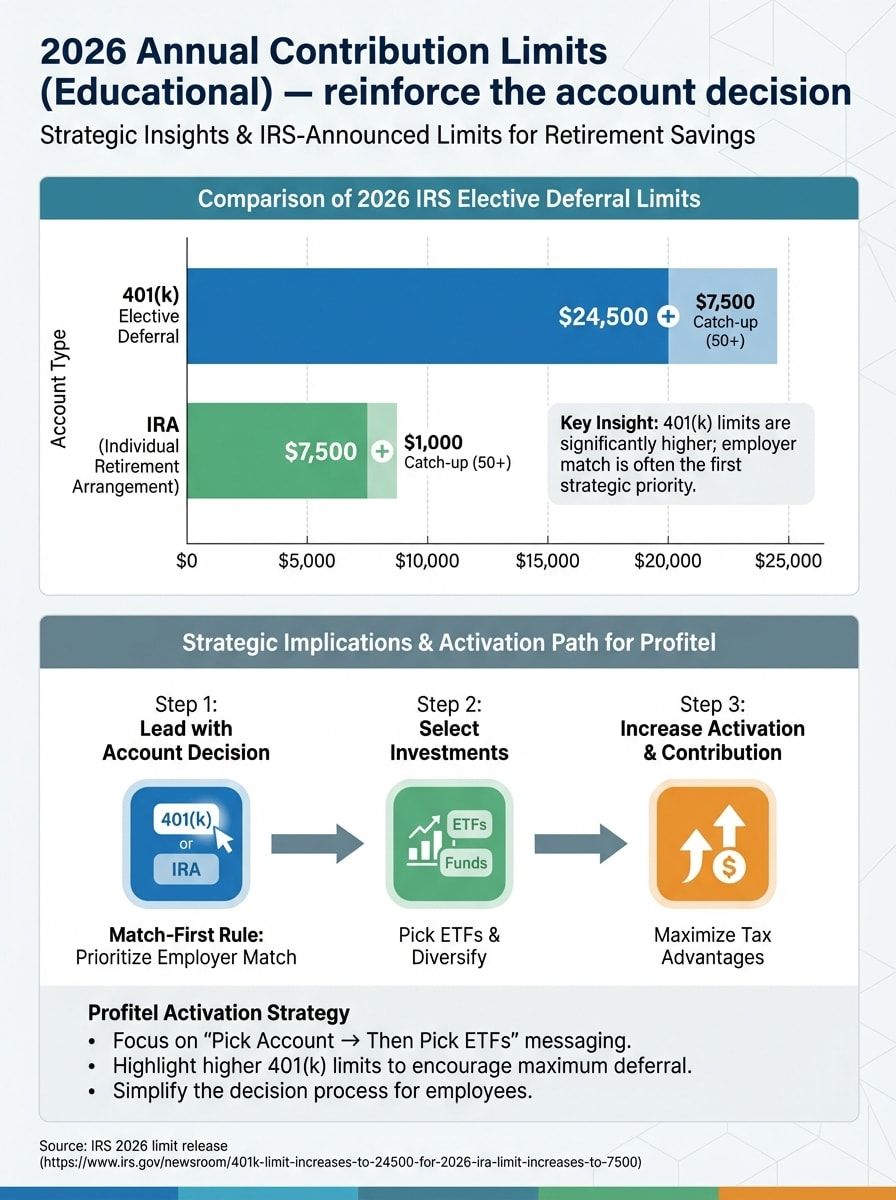
2026 Annual Contribution Limits (Educational) — reinforce the account decision
🎨
Chart shows: Data represents: IRS-announced 2026 limits for 401(k) elective deferrals and IRAs. Key insights: 401(k) limits are higher; match-first is a common starting rule. Strategic implications: Profitel can increase activation by leading with “pick account → then pick ETFs.” 401(k): $24,500 |█████████████████████████████| IRA: $7,500 |█████████| Source: IRS 2026 limit release ---...
Company materials indicate the intended flow: risk quiz → model portfolio template → one-click allocation → recurring buys → rebalance alerts (±5% or quarterly) → taxable guardrails (TLH education, wash-sale warnings). (Company materials: 01_FULL_BUSINESS_PLAN.pdf; 02_TOP10_COMPETITOR_REPORT.pdf)
Company materials indicate permissible positioning focuses on tools and transparency: AI-assisted portfolio building, ETF-specific analytics, risk controls, and clear pricing. Claims should be framed as process and features, not performance. Company materials also describe monetization via SaaS tiers (Silver/Gold/Platinum), advisor seat licensing, and institutional packages, with a roadmap prioritizing reliability and activation before broader expansion. (Company materials: 01_FULL_BUSINESS_PLAN.pdf; 02_TOP10_COMPETITOR_REPORT.pdf; 04_DEVELOPMENT_ROADMAP_AND_TIMELINES.pdf; 06_EMAIL_TEMPLATES.pdf)
Company materials indicate Profitel pricing: 0.25% AUM (waived under $10K), no trading commissions. (Company materials: 01_FULL_BUSINESS_PLAN.pdf; 06_EMAIL_TEMPLATES.pdf)
“Is now a bad time?” Emphasize automation + an IPS to reduce timing decisions; behavior research is a core rationale. Morningstar—Mind the Gap
“Isn’t this what robo-advisors do?” Yes on automation; Profitel differentiates by making “why this portfolio” and the rebalancing rules more transparent and customizable. Wealthfront pricing, Vanguard robo-advisor
“Fees will eat returns.” Show “all-in cost” and use the fee illustration to explain compounding drag. Morningstar—fee research
Recommended CTA stack (choose based on funnel stage): (a) Risk Quiz landing page, (b) One-click Portfolio Builder, and/or (c) email capture (“Get the 1-page IPS + rebalance bands template”). (Company materials: 01_FULL_BUSINESS_PLAN.pdf)
Company materials indicate KPI categories (without providing verified numeric goals in the excerpt): retail activation rate, conversion (free→paid), and 90-day retention; plus advisor and institutional adoption metrics. (Company materials: 03_CLIENT_SEGMENTS_AND_ENTERPRISE_OFFER.pdf; 01_FULL_BUSINESS_PLAN.pdf)
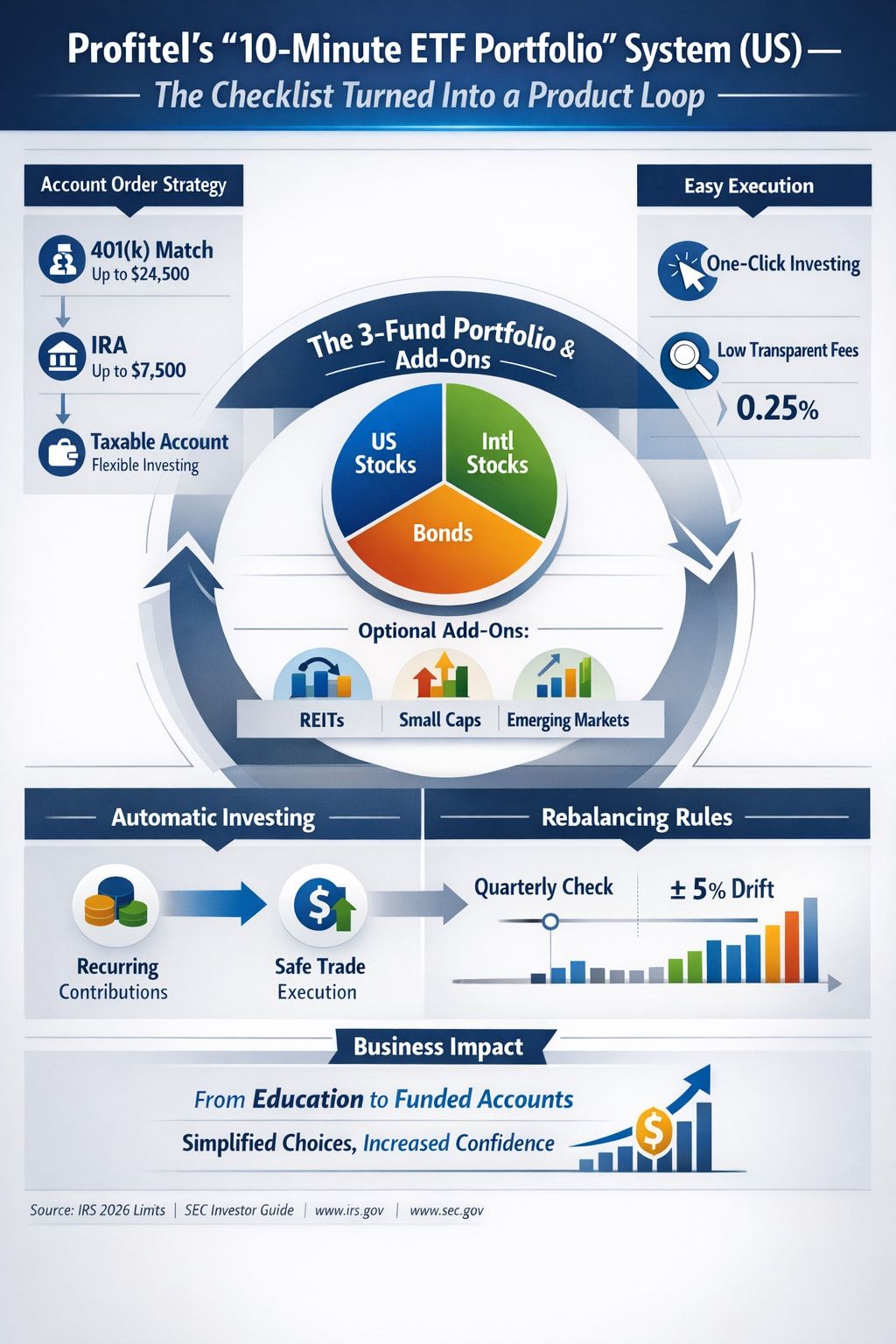
Visual focus: account order (401(k) match → IRA → taxable), 3-fund default with optional add-ons, safe trade execution, recurring investing, and rebalancing by quarterly check or ±5% drift; plus Profitel’s one-click implementation and fee transparency. Business impact: converts education into funded accounts by reducing choices while increasing confidence. IRS 2026 limit release, SEC Guide ---
Regulators / IRS
SEC Investor Bulletin—ETFs: https://www.investor.gov/index.php/introduction-investing/general-resources/news-alerts/alerts-bulletins/investor-bulletins-24
SEC Guide—Mutual Funds & ETFs: https://www.sec.gov/about/reports-publications/investor-publications/introduction-mutual-funds
SEC Investor Bulletin—Order Types: https://www.investor.gov/index.php/introduction-investing/general-resources/news-alerts/alerts-bulletins/investor-bulletins-14
IRS—2026 retirement limits press release: https://www.irs.gov/newsroom/401k-limit-increases-to-24500-for-2026-ira-limit-increases-to-7500
IRS—Matching contributions: https://www.irs.gov/retirement-plans/matching-contributions-help-you-save-more-for-retirement
IRS Topic 409: https://www.irs.gov/taxtopics/tc409
IRS Pub 550: https://www.irs.gov/publications/p550
IRS Pub 590-A: https://www.irs.gov/publications/p590a
IRS Pub 590-B: https://www.irs.gov/publications/p590b
IRS—NIIT: https://www.irs.gov/individuals/net-investment-income-tax
IRS Topic 559: https://www.irs.gov/taxtopics/tc559
IRS Pub 514 (Foreign Tax Credit): https://www.irs.gov/publications/p514
IRS—FTC compliance tips (foreign tax credit): https://www.irs.gov/individuals/international-taxpayers/foreign-tax-credit-compliance-tips
IRS—Instructions for Form 1116: https://www.irs.gov/instructions/i1116
IRS—Instructions for Form 1099-DIV: https://www.irs.gov/instructions/i1099div
FINRA
FINRA—Order Types: https://www.finra.org/investors/investing/investment-products/stocks/order-types
FINRA—Leveraged/inverse ETPs: https://www.finra.org/investors/insights/lowdown-leveraged-and-inverse-exchange-traded-products
FINRA Regulatory Notice 09-31: https://www.finra.org/rules-guidance/notices/09-31
ETF/fund providers & product pages
Vanguard VTI fact sheet: https://institutional.vanguard.com/assets/corp/fund_communications/pdf_publish/us-products/fact-sheet/F0970.pdf
Vanguard VXUS fact sheet: https://institutional.vanguard.com/assets/corp/fund_communications/pdf_publish/us-products/fact-sheet/F3369.pdf
Vanguard BND fact sheet: https://institutional.vanguard.com/assets/corp/fund_communications/pdf_publish/us-products/fact-sheet/F0928.pdf
Vanguard BNDX fact sheet: https://workplace.vanguard.com/assets/corp/fund_communications/pdf_publish/us-products/fact-sheet/F3711.pdf
iShares AGG product page: https://www.ishares.com/us/products/239458/ishares-core-total-us-bond-market-etf
iShares—ETF tax efficiency: https://www.ishares.com/us/investor-education/etf-education/how-are-etfs-tax-efficient
Vanguard—Understanding capital gains: https://corporate.vanguard.com/content/corporatesite/us/en/corp/articles/understanding-capital-gains.html
Vanguard—Principles: https://corporate.vanguard.com/content/corporatesite/us/en/corp/about-our-funds/how-we-invest/principles-for-investing-success.html
Vanguard—Rebalancing edge PDF: https://corporate.vanguard.com/content/dam/corp/research/pdf/the_rebalancing_edge_optimizing_target_date_fund_rebalancing_through_threshold_based_strategies.pdf
Vanguard—Balancing act article: https://corporate.vanguard.com/content/corporatesite/us/en/corp/articles/balancing-act-enhancing-target-date-fund-efficiency.html
Industry research
ICI ETF data (June 2025): https://www.ici.org/research/stats/etf/etfs_06_25
ICI Fact Book press release: https://www.ici.org/news-release/25-factbook
ICI 2025 Fact Book PDF: https://www.ici.org/files/2025/2025-factbook.pdf
S&P SPIVA US Year-End 2024 PDF: https://www.spglobal.com/spdji/en/documents/spiva/spiva-us-year-end-2024.pdf
S&P—US Persistence Scorecard: https://www.spglobal.com/spdji/en/spiva/article/us-persistence-scorecard
Morningstar—Mind the Gap landing page: https://www.morningstar.com/lp/mind-the-gap
Morningstar—Mind the Gap 2024 PDF: https://www.morningstar.com/content/cs-assets/v3/assets/blt9415ea4cc4157833/bltebc45c862e642793/6759e563cbd7d6cef415ac94/Mind_the_Gap_2024.pdf
Morningstar—Fee predictor piece: https://sg.morningstar.com/sg/news/154499/how-fund-fees-are-the-best-predictor-of-returns.aspx
DALBAR press release (behavior gap example): https://www.dalbar.com/press-release/investors-missed-the-best-of-2024s-market-gains-latest-dalbar-investor-behavior-report-finds/
State Street—tax efficiency structural: https://www.ssga.com/us/en/individual/insights/tax-efficiency-is-structural-etfs-continue-to-issue-fewer-capital-gains-than-mutual-funds
Oxford RFS paper (ETF tax & rise): https://academic.oup.com/rfs/advance-article/doi/10.1093/rfs/hhaf044/8191041
Broker/robo pricing & features
Betterment pricing: https://www.betterment.com/pricing
Betterment TLH methodology: https://www.betterment.com/resources/tax-loss-harvesting-methodology
Wealthfront pricing: https://www.wealthfront.com/pricing
Vanguard robo-advisor overview: https://investor.vanguard.com/advice/robo-advisor
Schwab Intelligent Portfolios: https://www.schwab.com/intelligent-portfolios
NerdWallet Schwab IP review: https://www.nerdwallet.com/investing/reviews/schwab-intelligent-portfolios
Fidelity—Recurring investments: https://www.fidelity.com/learning-center/trading-investing/recurring-investment
Robinhood—Recurring investments: https://robinhood.com/support/articles/recurring-investments/
Fidelity—Roth IRA limits: https://www.fidelity.com/learning-center/smart-money/roth-ira-contribution-limits
Fidelity—401(k) match: https://www.fidelity.com/learning-center/smart-money/average-401k-match
Policy / academic allocation references
Brinson et al. (FAJ abstract page): https://www.tandfonline.com/doi/abs/10.2469/faj.v51.n1.1869
Allocation “90%” critique/discussion: https://www.pipsbenchmark.com/2011/11/no-asset-allocation-does-not-determine-90percent-performance.html
Rick Ferri rebalancing: https://www.forbes.com/sites/rickferri/2013/02/21/choices-in-portfolio-rebalancing/
FTC disclosure
FTC Endorsement Guides hub: https://www.ftc.gov/business-guidance/resources/ftcs-endorsement-guides
FTC Disclosures 101: https://www.ftc.gov/influencers
16 CFR 255.5 (material connections): https://www.law.cornell.edu/cfr/text/16/255.5
Educational content only. Not investment advice. All investing involves risk.